[News] Incheon Sejong Hospital Launches as Regional Responsible Medica…
Date: 2024-08-29
본문
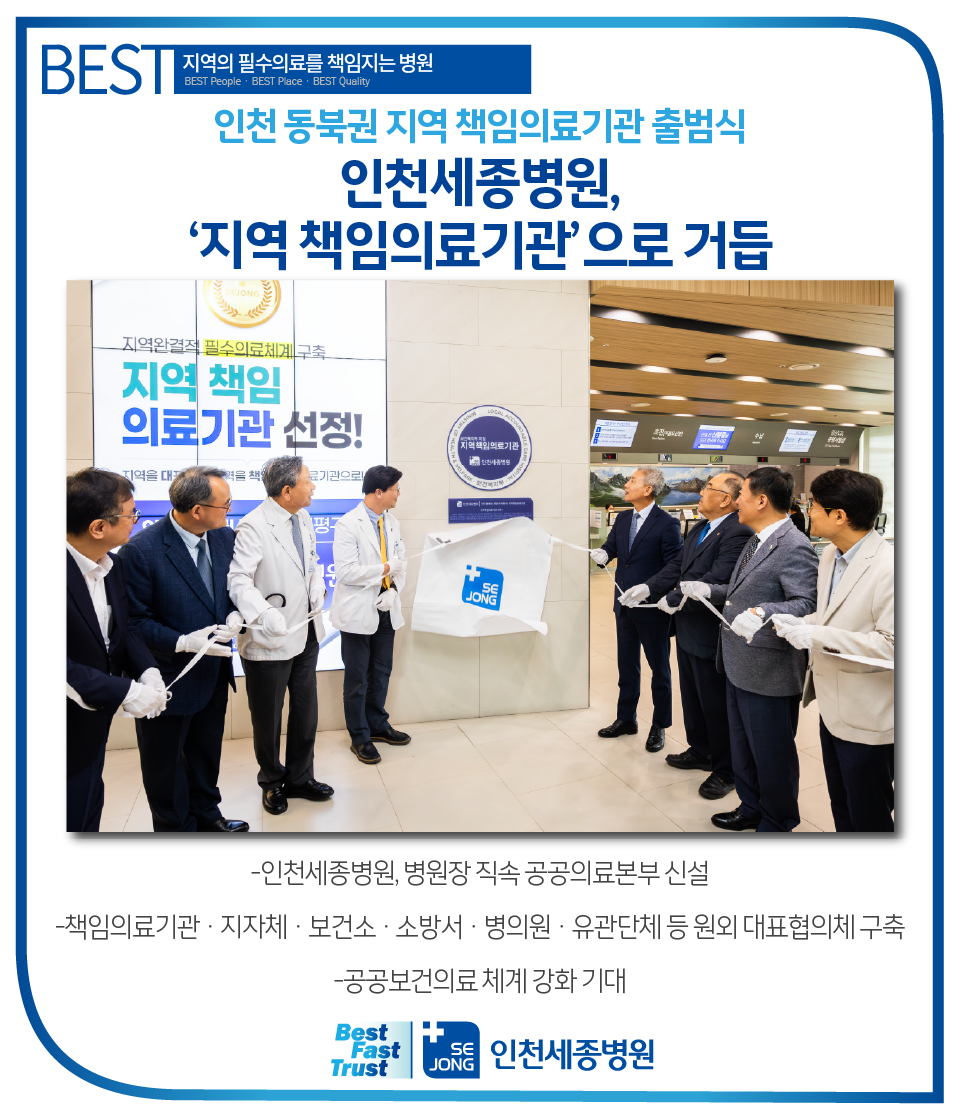
▲ On Tuesday the 27th, at the main lobby of Incheon Sejong Hospital, attendees including Park Jin‑sik, Chairman of the Hye-won Medical Foundation
Sejong Hospital (fourth from the left in the photo), and Yoon Hwan, Mayor of Gyeyang District (fifth from the left), are pictured unveiling the commemorative plaque for the designation as a Regional Responsible Medical Institution.
────────
Incheon Sejong Hospital (President Oh Byung-hee) announced on Wednesday the 28th that it held the Launch Ceremony as a Regional Responsible Medical Institution, along with the 1st External Representatives Council Meeting, on Tuesday the 27th at the Vision Hall of the hospital’s main building.
The Responsible Medical Institution system is a government-led model designed to address challenges such as insufficient supply in essential but low-profit healthcare services, weak linkage among regional medical services, and declining public healthcare capacity.
Under the Public Health and Medical Services Act, the core objective is to establish a cooperative public healthcare system involving the Ministry of Health and Welfare, metropolitan and provincial governments, the National Medical Center, and designated Responsible Medical Institutions across regions.
Responsible Medical Institutions are classified into two categories: Regional (Wide-Area) and Local.
Wide-area Responsible Medical Institutions operate at the metropolitan or provincial level (17 regions nationwide), providing highly specialized essential medical services. They also play a key role in planning and coordinating regional cooperation systems, strengthening medical capacity, and supporting education
and personnel dispatch.
Local Responsible Medical Institutions operate within designated medical service areas (70 nationwide), providing high-quality essential medical services while serving as regional hubs that coordinate and collaborate with local public health institutions to resolve region-specific healthcare challenges.
Incheon Sejong Hospital was designated in April by the Ministry of Health and Welfare as the Local Responsible Medical Institution for the Northeastern
Incheon area, covering Gyeyang-gu and Bupyeong-gu.
The hospital explained that this designation was influenced by its strong medical capabilities, noting that it performs the largest number of cardiac surgeries in Incheon and maintains extensive surgical and procedural experience in cerebrovascular and other critical care fields. It also cited achievements such as receiving hospital accreditation for two consecutive cycles, designation as a Regional Emergency Medical Center, selection as a National Relief Hospital during the COVID-19 pandemic, operation as a dedicated treatment hospital for critically ill patients, and dispatch of medical staff to residential treatment
centers—demonstrating its continued commitment to resolving regional healthcare crises.
Following its designation, Incheon Sejong Hospital implemented several internal and external organizational changes.
First, it established the Public Healthcare Division, reporting directly to the hospital president, led by Vice President for Medical Affairs Hong Kyung-seop. The division consists of two physicians, four nurses, one researcher, and one social worker, and oversees both the Public Healthcare Cooperation
Office and the Regional Emergency Center.
In addition, the hospital formed an internal consultative body integrating the Medical Affairs Division, Public Healthcare Division, Nursing Department,
and other collaborating departments to strengthen interdepartmental cooperation.
Notably, the hospital established the External Representatives Council, chaired by Hospital President Oh Byung-hee, regarded as the centerpiece
of the public healthcare cooperation system.
The council brings together Incheon Sejong Hospital as the lead Local Responsible Medical Institution, along with wide-area Responsible Medical Institutions, local governments, government-designated centers, public health centers, fire departments, hospitals and clinics, regional medical associations,
and welfare organizations.
President Oh stated,
“Cooperation among diverse institutions has been strengthened to improve public healthcare services. By gathering perspectives from various
stakeholders, we expect to develop more practical and effective solutions.”
He added,
“As a Regional Responsible Medical Institution, we feel a profound sense of responsibility. Through this cooperative system, we will do our utmost to strengthen accountability in essential medical services that directly affect the lives and health of our citizens, while delivering high-quality and efficient medical care.”


