[News] Bucheon Sejong Hospital Safely Performs Minimally Invasive Coro…
Date: 2026-02-19
본문
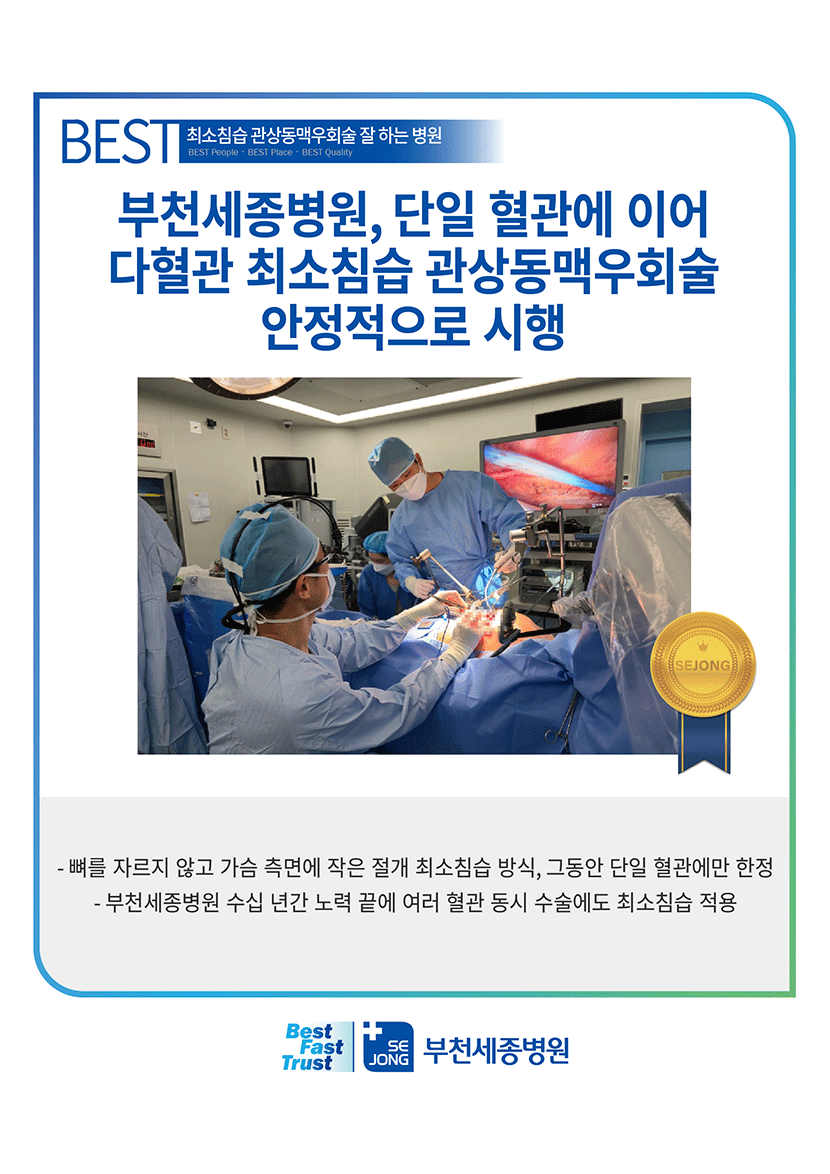
Bucheon Sejong Hospital, led by President Lee Myung-mook, is further strengthening trust by safely performing minimally invasive coronary artery bypass surgery not only for single-vessel disease but also for patients with multivessel coronary artery disease.
According to Bucheon Sejong Hospital on the 19th, minimally invasive coronary artery bypass surgery for multivessel disease is regarded as a more advanced surgical technique compared to previous approaches. This is because minimally invasive coronary artery
bypass grafting (MICS CABG) had mainly been performed for single-vessel disease until now.
Medical staff from the Department of Cardiovascular Thoracic Surgery at Bucheon Sejong Hospital are performing minimally
invasive coronary artery bypass surgery for multivessel disease.
Over several decades, Bucheon Sejong Hospital has continuously advanced its surgical techniques and has ultimately succeeded in applying minimally invasive coronary artery bypass surgery even to cases requiring surgery for multivessel coronary artery disease, in which lesions are present in multiple blood vessels.
Dr. Lee Hee-moon, a cardiovascular thoracic surgeon at Bucheon Sejong Hospital, explained, “Multivessel coronary artery bypass surgery had long been considered difficult to perform using a minimally invasive approach, but we have overcome this limitation through dedicated efforts.”
The coronary arteries are blood vessels that supply blood to the heart. When these vessels become narrowed or blocked, conditions such as angina or myocardial infarction can occur. Coronary artery bypass surgery is a procedure that restores blood flow by connecting a bypass vessel to the affected coronary artery.
Typically, this surgery is performed by making an incision in the center of the chest through a median sternotomy.
However, in 2000, Bucheon Sejong Hospital drew national attention by becoming the first in Korea to perform minimally invasive direct coronary artery bypass surgery (MIDCAB), in which a small incision is made on the left side of the chest and endoscopic instruments are inserted to perform the procedure. In March of last year, the hospital also became the first in Korea to surpass 200 cases.
The advantages of minimally invasive coronary artery bypass surgery are clear. Because it does not require cutting through bone or widely opening the chest, it reduces recovery time and lowers the risk of complications. Minimal scarring also leads to higher cosmetic satisfaction among patients. The approach is also effective in reducing the psychological gap between interventional procedures and surgery.
However, minimally invasive coronary artery bypass surgery requires extensive experience and advanced surgical skills, as the surgical field of view is more limited than in median sternotomy. The role of experienced anesthesiologists and nursing teams is also a key factor in determining surgical quality.
As Korea’s only heart-specialty hospital, Bucheon Sejong Hospital has overcome the challenges of minimally invasive heart surgery through more than 40 years of expertise in heart treatment, a multidisciplinary care system, and continuous research.
Lee Myung-mook, President of Bucheon Sejong Hospital, said, “We plan to expand minimally invasive surgery not only for multivessel coronary artery disease but also into various fields of heart surgery, including robotic surgery.”
He added, “We will build a more precise and safer surgical system to realize advanced, patient-centered cardiac care.”
첨부파일
-
20260224_다혈관-최소침습-관상동맥우회술.png (18.9K)
2 downloads | DATE : 2026-06-02 16:12:19


