
[News] Bucheon Sejong Hospital’s Dr. Kim Su-jin Leads Establishment of…
Date: 2025-10-22
본문
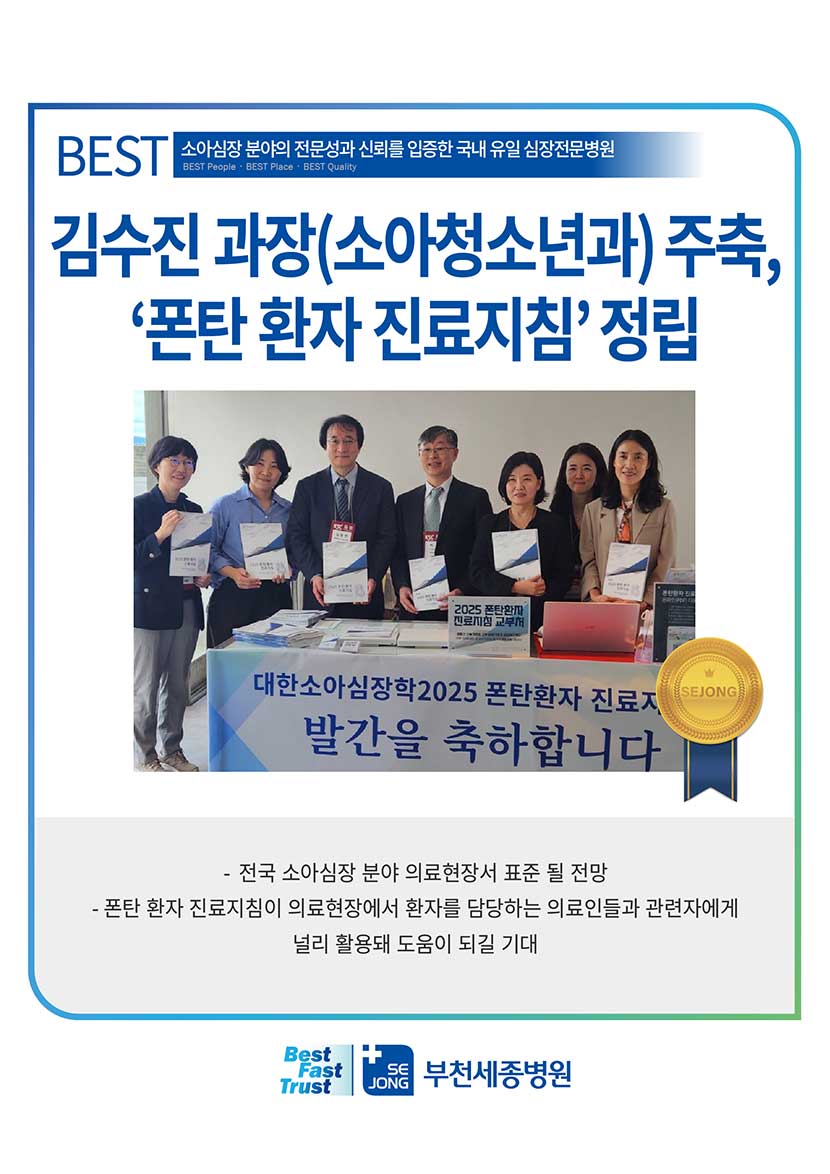
Clinical guidelines for patients with the rare condition Fontan circulation—developed under the leadership of Dr. Kim Su-jin (Department of Pediatrics) at Bucheon Sejong Hospital—are expected to become a national standard in pediatric cardiology practice.
Bucheon Sejong Hospital announced on the 22nd that Dr. Kim presented the guidelines at the Korean Society of Cardiology 69th Autumn Scientific Meeting 2025, held on the 17th at the Grand Walkerhill Hotel in Gwangjin-gu, Seoul.
These Fontan patient clinical guidelines are the first officially endorsed guidelines by the Korean Society of Pediatric Cardiology. Beyond setting standards in pediatric cardiology, the guidelines aim to provide evidence-based, Korea-specific recommendations for clinicians and researchers caring for patients who have undergone the Fontan procedure. They also serve as a practical educational resource for residents, fellows, and educators involved in training.
Beginning in 2023, members of the Korean Society of Pediatric Cardiology—including Dr. Kim—identified the need to develop guidelines for Fontan patients, one of the most complex and challenging rare conditions in cardiology. A dedicated Fontan Guideline Development Committee was formed, and after more than two years of extensive research, repeated meetings, and consensus-building, the group achieved this milestone. Dr. Kim served as chair of the committee, with pediatric cardiologists from major hospitals nationwide—including Bucheon Sejong Hospital—participating as development, editorial, and review committee members.
Dr. Kim explained the background of the initiative, noting, “With very few new pediatric cardiology specialists entering the field, and with specialists increasingly concentrated in the metropolitan area and aging, pediatric cardiac care is facing serious challenges. At the same time, the number of residents and fellows in training is extremely limited, raising concerns that essential clinical knowledge could be lost. Preserving, transferring, and documenting accumulated expertise has therefore become an important clinical and educational responsibility for physicians currently in practice.”
“Fontan patients” refers to individuals who have undergone the Fontan procedure, a surgical approach designed for patients born with a single functional ventricle. Because these patients must rely on one ventricle to support both systemic and pulmonary circulation, they are prone to low arterial oxygen saturation and chronic ventricular overload, often leading to congestive heart failure and pulmonary hypertension, which historically limited survival beyond the age of 40. The Fontan procedure improves long-term survival by routing blood to the pulmonary arteries without direct ventricular involvement. Globally, an estimated 50,000–70,000 Fontan patients exist, with approximately 1,700 in Korea as of 2019. Although surgical advances have improved survival, the unique hemodynamics of Fontan circulation predispose patients over time to complications such as circulatory failure, heart failure, arrhythmias, and peripheral organ dysfunction.
Accordingly, the new guidelines comprehensively address Fontan circulatory failure, ventricular dysfunction, Fontan-associated liver disease, pharmacologic management of heart failure, diagnosis and treatment of arrhythmias, protein-losing enteropathy, thromboembolism, exercise, pregnancy and childbirth, and recommendations for screening and follow-up. They also provide clear guidance on key clinical questions commonly encountered in practice, such as whether thromboprophylaxis or pulmonary hypertension medications are beneficial in Fontan patients.
To ensure real-world relevance, the guideline development process incorporated surveys of society members to identify the most frequent clinical questions. Scientific rigor was strengthened through meta-analyses and systematic reviews, while methodological validity and reliability were enhanced through consultation and participation by experts from national institutions, including the National Evidence-based Healthcare Collaborating Agency (NECA). The multi-center, nationwide collaboration—including major regional hospitals—further reinforced the guidelines’ clinical applicability.
Dr. Kim Su-jin of Bucheon Sejong Hospital stated, “I would like to express my sincere gratitude to all the healthcare professionals who worked tirelessly to establish these Fontan patient clinical guidelines. I hope these guidelines will be widely utilized in clinical practice and provide meaningful support to healthcare professionals and all those involved in caring for Fontan patients.”
첨부파일
-
10029.jpg (12.6K)
7 downloads | DATE : 2025-11-21 12:29:43


